
When the Dock Gets Crowded: A Quick Reality Check
I’ve seen a quiet Monday turn wild in five minutes flat. The pallet stacker sat two lanes over while a line of pallets crept past the yellow tape, like cattle pushin’ the fence. By the numbers, the crew was on pace, but the site data said we were burning 12% more time in handoffs and aisle resets. One small pause in staging, and you feel it down the whole line—y’all know that feeling. And when the PLC alarms start blinking, the radio chatter jumps, and IoT telemetry still lags by a hair, well, that’s a mess in a hurry. So here’s the rub: if minutes swing margins, what’s the real cost of slow change?
We’ve been told to add bodies, add bins, and add buffer zones. But overtime costs keep biting, and space is not cheap. So I’m asking: if the floor’s already tight, and the shifts keep stacking, where do we actually squeeze out time without squeezing folks? Let’s see what the data hides (bless its heart), and who pays for those hidden stops. Alright, let’s head to the root cause.
The Hidden Friction Behind “Good Enough” Workflows
Where do the delays hide?
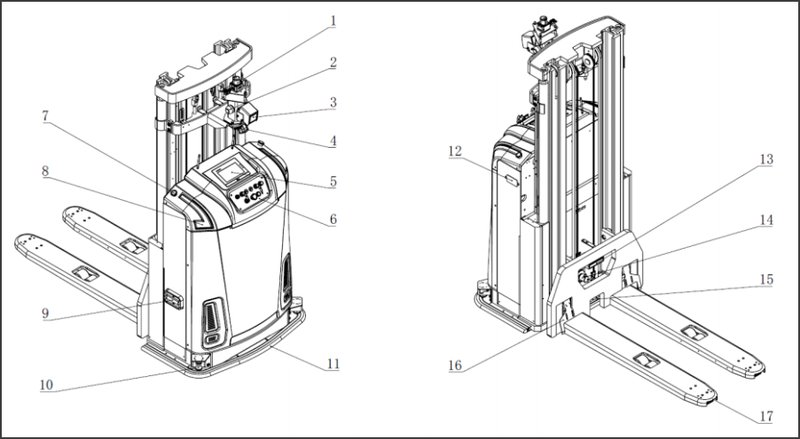
Let’s take a technical look. An automatic pallet stacker seems like a straight swap for a manual or ride-on unit, but the real win sits in the micro-stops. Traditional setups mask little losses: 18 seconds lost in re-aiming forks, 30 seconds in aisle negotiation, 45 seconds in rework when labels don’t scan. Multiply that over hundreds of cycles, and you’ve got hours gone—funny how that works, right? Sensors like LiDAR get you tighter pathing. SLAM maps keep routes steady even when racks shift. A clean CAN bus cuts chatter between modules so lift, tilt, and travel talk smooth. Torque sensors on the mast trim wobble that used to mean reset time. Look, it’s simpler than you think: shave the tiny stumbles, and the big wins roll in by themselves.

Hidden pain points show up where the spec sheet stays quiet. Mixed pallets cause fork loom-outs. Queue gaps grow because two pickers reach the aisle at once. And a nice wide turn becomes a three-point dance when film wrap sticks. Older semi-auto gear doesn’t learn; it just repeats. Newer control loops adapt to the floor and people. They read repeat patterns—shift changes, dock jams, and battery sag—then act. That’s where uptime climbs. Tie it to the WMS, and your pacing syncs with real orders, not wishful thinking. The outcome? Less back-and-forth and fewer “hold on, let me fix that” moments that tire folks out and chew margins.
Comparative Outlook: Principles That Push Stackers Ahead
What’s Next
From here, look forward, not just faster. The new baseline isn’t about a single unit moving quicker. It’s a system that learns the rhythm of your floor. Picture this: edge computing nodes on the dock run local routing so latency drops even when the Wi-Fi hiccups. Power converters paired with smart battery packs pace charge windows with shift breaks. Fleet orchestration balances three or ten units so no aisle gets swamped. And your automatic pallet stacker doesn’t just drive; it predicts when a lane will clog and slips to a side task till it clears. Compared to yesterday’s semi-auto approach, the difference isn’t speed alone—it’s fewer stalls, cleaner handoffs, and steadier cycle time under stress.
So, what should you measure as you move from “it works most days” to a truly resilient flow? First, compare path stability under change: shifting pallets, floor tape moved, pop-up inbound. Second, monitor human-in-the-loop load—how often does a worker need to intervene, and how long? Third, check energy-to-throughput: watt-hours per pallet lifted, not just hours per charge. Summing up our earlier points: the tiny stumbles cost more than the big fixes, and adaptive control pays back by trimming those stumbles at the source—one micro-stop at a time. Choose the tool that learns, not the one that just runs. That’s the lesson the floor keeps teaching—whether we like it or not. For more grounded tech thinking, straight from builders, see SEER Robotics.